
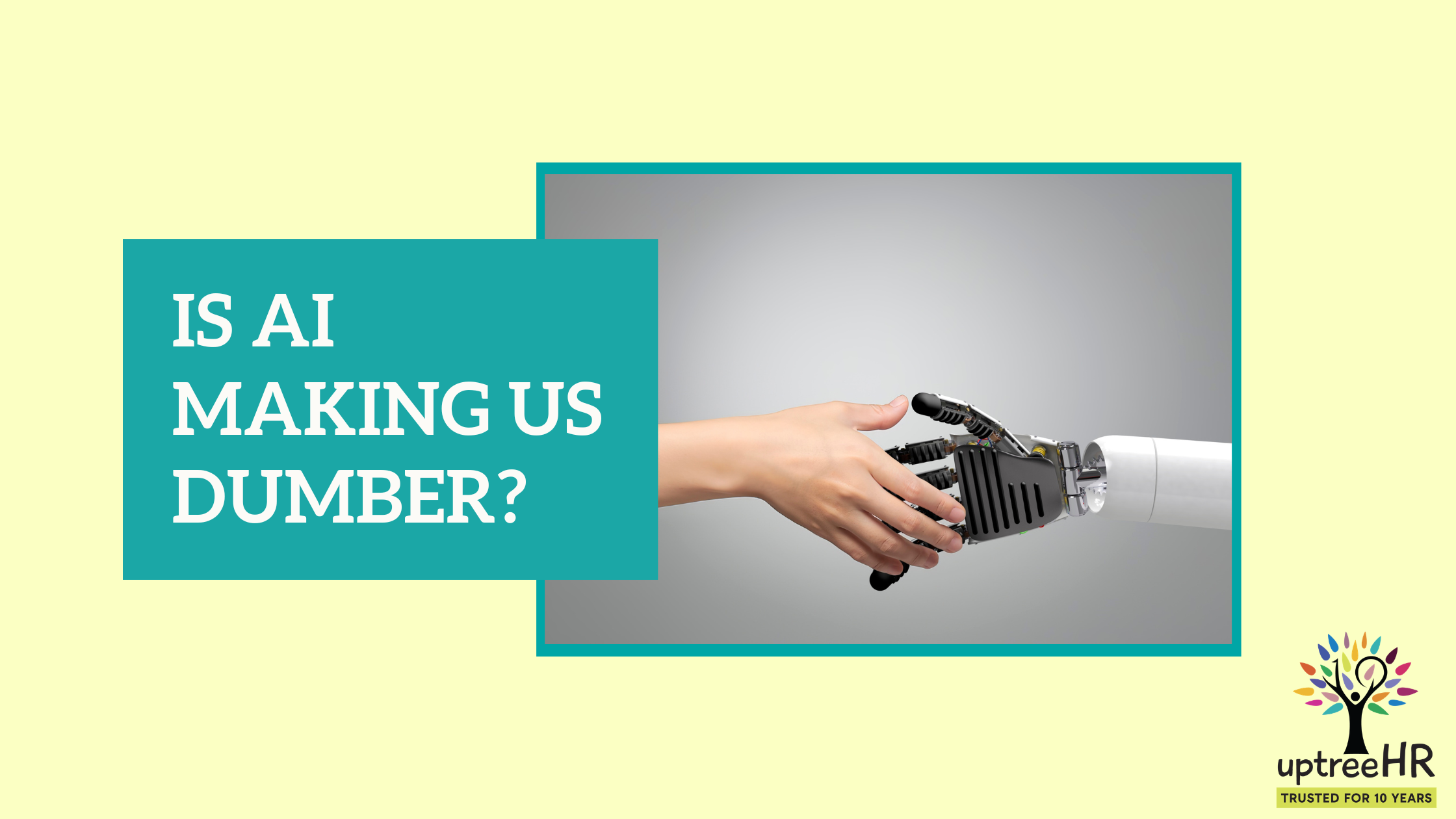
When I made my first ChatGPT account in 2023, I was blown away by how much more efficient I could be. Need an agenda for a training session? Interview questions for a recruitment project? A strong opening sentence for a policy? Familiar tasks started to become much, much faster. I was moving at record speed!
Over time, I began integrating AI tools into my daily work as a consultant. And while I have always been careful to consider concerns around confidentiality and intellectual property, now three years in, a new question has started to nag at me that I hadn’t fully considered:
Is AI making us dumber?
What the Research Shows
A recent study conducted by a team of Microsoft researchers suggests the answer might be yes, at least in certain ways. The study surveyed 319 workers, asking how they use AI tools and how this use affects their perception of their own critical thinking skills. They found (Perhaps not surprising in hindsight) that the more participants relied on AI, the less they reported actively exercising their critical thinking skills.
I recently listened to a podcast featuring Dr. Zak Stein, founder of an organization called the AI Psychological Harms Research Coalition, whose research has mirrored that of Microsoft’s. Dr. Stein uses an interesting metaphor: The brain works like a muscle. If you stop using a muscle group, it begins to weaken. The same is true for cognitive skills. In other words, when we consistently offload thinking tasks to AI – Writing, synthesizing, deciding – We may start losing our ability to do those things ourselves.
So What Do We Do About it?
It’s unrealistic to suggest people stop using AI altogether; It is already embedded into everyday tools, from email platforms to Google searches. And in many workplaces, not using AI can put you at a disadvantage when it comes to managing productivity in relation to your peers.
So, here are some practical ways to consider leveraging AI intelligently while protecting your cognitive capacity.
1) Determine What “Muscles” You’re Willing to Let Weaken
This idea comes from Dr. Stein, and I think it’s a helpful one. If relying on AI means certain cognitive skills may decline, then we need to be intentional about which skills those are. Consider asking yourself:
- What skills would I be okay with losing some efficiency/proficiency if AI handled them for me?
- What areas would I not be okay with seeing a decline in skill?
- How am I using AI today that may be contributing to a decline in the cognitive skills I do want to keep?
2) Create Space for More Metacognition
Metacognition is really just a fancy term for, “thinking about your own thinking”. This concept has been a large part of Dr. David Rock’s work, the founder of the NeuroLeadership Institute. His research shows that engaging in metacognition can help counteract cognitive atrophy. When we reflect on how we think, we strengthen neural connections that support learning, memory, and intelligence, and some research has found this can even reduce anxiety and improve happiness.
This means that we should be trying to offload tasks that free up time for us to think more – Like figuring out how to not get bogged down in repetitive, administrative tasks so we can have more time to engage in more high-level thinking (Problem-solving, brainstorming, etc.)
3) Leverage AI Tools Over Generative AI
Instead of defaulting to generative AI to improve your efficiency, consider looking into other AI tools that can enhance your efficiency without replacing cognition, such as:
- AI meeting note-takers
- Smart scheduling assistants
- Task prioritization and workflow tools
- Automated data entry or expense tracking
These tools reduce cognitive overload while keeping your high-level thinking skills intact.
4) Be Cognizant of Cognitive Weakening
Finally, simply paying attention can go a long way.
Are you noticing that:
- You struggle more to catch spelling or grammar errors on your own?
- You can’t start an email without AI-generated opening lines?
- You rely on AI to phrase even straightforward feedback?
If so, that may be a signal that certain cognitive “muscles” haven’t been used in a while.
Final Thoughts
Leveraging AI shouldn’t (and doesn’t have to) come at the expense of our cognitive abilities. Amid all the pressure to “stay ahead” of the AI curve, it’s worth remembering that the real competitive advantage won’t go to those who use AI the most, but to those who know when to use it.
Addy Smith is an HR Partner at uptreeHR, an outsourced Human Resource department for small to medium-sized businesses. Erin and the team are based in Halifax, Nova Scotia.
To book a complimentary 30-minute consult with uptreeHR, click here.
Leave A Comment
For many business owners, reaching 10 employees feels like a [...]
Many employers follow this hiring process: send a brief offer letter [...]
One of the most common leadership mistakes arises in our most [...]
Since Covid, many workplaces have focused on the same question, should [...]